

Ratio logo white

Ratio is an interdisciplinary research institute, with a research focus on the conditions of business and enterprise.

08-441 59 00info@ratio.se

802002-5212

Sveavägen 59 4trp

11359 Stockholm

Bankgiro: 512-6578

PublicationsSeminarsPeople

Popular

News archive
Publications
Seminars
People
Start
About
Contact us
Labour market research
Competitiveness research
Climate and environmental research
Swedish flag iconPå svenska
PublicationBook

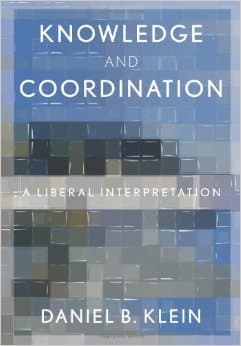
Knowledge and Coordination a liberal Interpretation

Abstract

Too often in economics the understanding of how things work by and large–not axiomatically or categorically–and the idea that we generally cannot know the economic system well enough to intervene into it beneficially are done less than justice. Yet they were Adam Smith’s central messages for public policy, and they authorized a presumption of liberty, thus exceptions to liberty should be treated as exceptional and bear the burden of proof.

In Knowledge and Coordination, Daniel Klein reexamines the elements of economic liberalism. He interprets Friedrich Hayek’s notion of spontaneous order from the aestheticized perspective of an allegorical Smithian spectator. Klein addresses issues economists have had surrounding the notion of coordination by distinguishing the concatenate coordination of Hayek, Ronald Coase, and Michael Polanyi from the mutual coordination of Thomas Schelling and game theory. Clarifying the meaning of “cooperation,” he resolves debates over whether entrepreneurial innovation enhances or upsets coordination. Entrepreneurship is interpreted in terms of discovery, or new knowledge. He points out that beyond information, knowledge entails interpretation and judgment. Rejecting homo economicus, Klein offers a distinctive formulation of knowledge economics, entailing asymmetric interpretation, judgment, entrepreneurship, error and correction. This richness of knowledge joins agent and analyst, and meaningful theory depends on tacit affinities between the two, even common contacts with an allegorical spectator. Knowledge and Coordination illuminates the recurring connections to underlying purposes and sensibilities, of analysts as well as agents.

Knowledge and Coordination is an imaginative and insightful take on how, by confessing the looseness of its judgments and the by-and-large status of its claims, laissez-faire liberalism makes its economic doctrines more robust and its presumption of liberty more viable.

Klein, D. (2011). Knowledge and Coordination a liberal Interpretation. Oxford: Oxford University Press.
Details

Author
Klein, D.
Publication year
2011
Published in

Knowledge and Coordination: A Liberal Interpretation

Related

  • Associate Researcher

    Daniel Klein

    +17039931156dklein@gmu.edu

Similar content

Working paper

Ratio Working Paper No 343: Populism, Liberalism and the Quest for Meaning and Community

Karlson, N.
Download

Publication year

2020

Published in

-

Abstract

Liberalism is losing ground, while populist or even authoritarian nationalist regimes are on the rise. This paper argues that the causes of the decline are, at least partly, endogenous, that a narrow focus on economic efficiency and the successful critique of socialism and the welfare state have created an idea vacuum that has opened up for these illiberal tendencies. The conclusion is that a central challenge for liberalism is to offer a comprehensive idea and narrative about meaning and community that is not socialistic, conservative or nationalistic, but distinctly liberal, to counter these developments.

Article (with peer review)

The Idea Vacuum of Liberalism and the Quest for Meaning and Community

Karlson, N.

Publication year

2019

Published in

Journal of Contextual Economics

Abstract

Liberalism is losing ground, while populist or even authoritarian nationalist regimes are on the rise. This article argues that the causes of the decline are, at least partly, endogenous, that a narrow focus on economic efficiency and the successful critique of socialism and the welfare state have created an idea vacuum that has opened up for these illiberal tendencies. The conclusion is that a central challenge for liberalism is to offer a comprehensive idea and narrative about meaning and community that is not socialist, conservative or nationalist, but distinctly liberal, to counter these developments.

Article (with peer review)

The openness of open innovation in ecosystems

Öberg, C., & Alexander, A.

Publication year

2019

Published in

Journal of Innovation & Knowledge

Abstract

Open innovation has rendered increased interest both in practice and research, and has expanded from dyadic transfers of ideas, to ecosystem levels. Knowledge is at the heart of open innovation, and this paper describes and discusses knowledge-transfer linkages for open innovation. It does so based on a literature review. The paper links together open innovation research with general management research to categorise and discuss linkages among parties in terms of their openness and how they relate to knowledge management. Conclusions indicate that openness needs to be considered in different dimensions that also links to different knowledge management outcomes. The paper’s contribution consists of how it connects open innovation research to the general management literature, and how it builds a practical understanding of how linkages between firms can be categorised to aid firms to consider which mechanisms they may choose and why.

Show more