Ratio is an interdisciplinary research institute, with a research focus on the conditions of business and enterprise.

+4684415900

info@ratio.se

802002-5212

Sveavägen 59 4trp

Box 3203

103 64 Stockholm

Bankgiro: 512-6578

About

  • About us
  • About
  • Contact us
  • Media
  • News archive
  • Cooperations
  • Eli F. Heckscher Lectures

Research

  • Areas
  • Labour Market Research
  • Competitiveness Research
  • Climate and Environmental Research
  • Ongoing research
  • Working Paper Series
People

Publications

  • Publications
  • Publications
Search Swedish flag iconSV
Swedish flag iconSVSearch

About

  • About us

    • About
    • Contact us
  • Media

    • News archive
  • Cooperations

    • Eli F. Heckscher Lectures

Research

  • Areas

    • Labour Market Research
    • Competitiveness Research
    • Climate and Environmental Research
  • Ongoing research

    • Working Paper Series
  • People
  • Publications

    • Publications

      • Publications

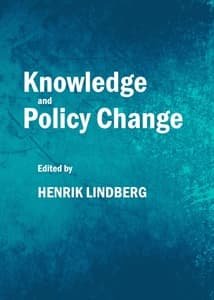
    Knowledge and Policy Change

    PublicationBook
    Företagandets villkor, Henrik Malm Lindberg, Nils Karlson, Peter Santesson-Wilson, Policyentreprenörer, Pragmatism, Reformer

    Abstract

    Knowledge and learning play important roles in policy change in advanced societies, and political processes cannot be properly understood if you neglect their significance. To understand how learning takes place and what role knowledge plays in the policy process, we need to have theoretical and methodological tools to analyse these features.

    In a research project on economic-political learning at the Ratio Institute a new book has been published edited by Henrik Lindberg. The conceptual framework for this volume, Knowledge and Policy Change (Cambridge Scholar Publishing 2012), focuses on issues such as belief systems, paradigmatic and pragmatic policy change, and the role of advocacy coalitions within policy subsystems. No less important is the role various forms of knowledge can and do play in the policy formation process.

    The book is structured around three main themes:
    • Theories of the policy process and the role of knowledge
    • Reform and restructuring of welfare states
    • Policy transfer, diffusion and implementation processes

    Lindberg, H. M. (Ed.). (2013). Knowledge and Policy Change. Newcastle, UK: Cambridge Scholars Publishing.
    Details

    Author

    Lindberg, H. M.

    Publication year

    2013

    Published in

    Newcastle UK: Cambridge Scholars Publishing

    Related

    Henrik Malm Lindberg
    Associate Researcher

    0768587956

    henrik.lindberg@ratio.se


    Similar content

    Working Paper No. 383 Insider activism in the forest industry: An empirical public choice analysis
    Working paperPublication
    Jonas Grafström & Nils Karlson
    Download
    Publication year

    2025

    Published in

    Ratio Working Paper Series

    Abstract

    Insider activism—where bureaucrats use discretionary power to advance own ideological goals—has significant implications for regulatory stability and property rights security. Using the Swedish forestry industry as a case study, the purpose of this study is to investigate if insider activism affects the Swedish forestry sector and how such possible regulatory uncertainty influences economic decision-making. Assembled survey data suggest that forest owners perceive regulatory enforcement as unpredictable, leading to defensive actions such as premature harvesting to preempt restrictive future regulations. To explain these patterns, we apply public choice theory and a game-theoretic approach, demonstrating how bureaucratic drift, regulatory ratcheting, and time-inconsistency problems contribute to persistent distortions in forestry policies. Policy wise, the findings emphasize the need for judicial review, regulatory impact assessments, and clearer legislative mandates to reduce enforcement uncertainty and improve institutional trust. This research advances discussions on bureaucratic incentives, regulatory capture, and legal certainty in environmental policy.

    Reviving Classical Liberalism Against Populism
    BookPublication
    Karlson, N. (2024). Reviving Classical Liberalism Against Populism. Palgrave Macmillan Cham.
    Publication year

    2024

    Published in

    Palgrave Macmillan Cham.

    Abstract

    How can we fight back against the populist threat to liberty, free markets, and the open society?

    This open access book by Nils Karlson explores the strategies used by left- and right-wing populists to make populism intelligible, recognizable, and contestable. Karlson argues that to fight back requires the revival of liberalism itself by defending and developing the liberal institutions, the liberal spirit, liberal narratives, and liberal statecraft. The book presents a synthesized explanatory model for how populists promote autocratization through the deliberate polarization of society and traces the ideational roots of the core populist ideas that form a collectivistic identity politics. Written within the tradition of political theory and institutional economics, this book uses a wide variety of sources, including results and analyses from social psychology, ethics, law, and history.

    The book is open source and can be downloaded through the link below.

    Ratio Working Paper No. 353: From free competition to fair competition on the European internal market
    Working paperPublication
    Karlson, N., Herold, T. & Dalbard, K.
    Download
    Publication year

    2022

    Published in

    Ratio Working Paper

    Abstract

    This paper investigates whether an increased use and reinterpretation of what has been called “fair competition” has occurred at the expense of “free competition” among the central institutions of the European Union. We are also interested in assessing how frequently these terms have been used by the various EU institutions over time.

    We have empirically examined this through a quantitative survey of more than 12,000 public documents, out of totally 242 000 documents containing 630 million words, in the EUR-lex database over the last 50 years, from 1970 to 2020. Our conclusion is that the emphasis of the common policies in the EU is likely to have shifted from free competition and an open market economy to “fair competition” in the sense of a level playing field, in official EU documents, such as treaties, EU acts institutions, preparatory documents relating to EU directives and recommendations including motions and resolutions, case law and more.

    The European Commission has been a driving force in this development, followed closely by the European Parliament and subsequently by the Council of Ministers. This change entails a risk that the regulation of the European internal market has shifted so that the dynamics of the internal market and thus the EU’s competitiveness will weaken. The change also entails a centralization of decisions at EU level at the expense of the Member States.

    Show more

    Selected publication

    Absolute income mobility and the effect of parent generation inequality: An extended decomposition approach
    Liss, E., Korpi, M., & Wennberg, K.

    Selected publication

    No evidence of counteracting policy effects on European solar power invention and diffusion
    Grafström, J., & Poudineh, R.