

Ratio logo white

Ratio is an interdisciplinary research institute, with a research focus on the conditions of business and enterprise.

08-441 59 00info@ratio.se

802002-5212

Sveavägen 59 4trp

11359 Stockholm

Bankgiro: 512-6578

PublicationsSeminarsPeople

Popular

News archive
Publications
Seminars
People
Start
About
Contact us
Labour market research
Competitiveness research
Climate and environmental research
Swedish flag iconPå svenska
PublicationBook

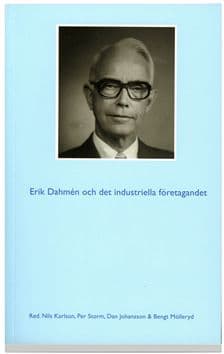
Erik Dahmén och det industriella företagandet

Abstract

Professor Erik Dahmén (1916 – 2005) var nestor inom svensk nationalekonomi. Han hade stor betydelse för svensk forskning, näringslivsutveckling och samhällsdebatt under mer än ett halvt sekel. Under lång tid var han professor vid Handelshögskolan i Stockholm och han var även nära knuten till Enskilda banken och Wallenbergsfären.

Samtidigt var han en mycket ovanlig nationalekonom. Han stod nämligen själv för en egen tradition som i väsentliga avseenden skiljer sig ifrån den idag dominerande bland nationalekonomer. Enligt Dahmén hade dessa ”låst in sig i verktygsboden” genom att ensidigt använda matematiska metoder och snävt fokusera på jämviktstillstånd och statistiska aggregat. Konsekvensen var att de därför tappat kontakt med den ekonomiska verkligheten.

För att kunna förstå ekonomisk utveckling och tillväxt krävs istället, menade Dahmén, att intresset riktas mot företagarverksamheten och marknadsprocessen. Det intressanta är innehållet i den industriella utvecklingen, d v s uppkomsten av nya varor, nya tekniker, nya organisationer och nya marknader och dessa nyheters kamp med och seger över äldre varor, metoder, etc. Utveckling och tillväxt förutsätter, enligt Erik Dahmén, omvandling.

I Erik Dahmén och det industriella företagandet belyser ett antal forskare från flera olika discipliner det dahménska perspektivet på tillväxt och ekonomisk utveckling ur ett framtidsperspektiv. Boken är ett resultat av ett samarbete mellan Kungliga ingenjörsvetenskapsakademien och Ratio – Näringslivets forskningsinstitut.

Karlson, N., Storm, P., Johansson, D. & Mölleryd, B. (Eds.) (2007). Erik Dahmén och det industriella företagandet. Stockholm: Ratio.
Medverkande forskare:
Bo Carlsson,
Gunnar Du Rietz,
Gunnar Eliasson,
Lennart Erixon,
Dan Johansson,
Nils Karlson,
Lennart Schön,
Hans Sjöberg,
Per Storm,
Juha Tarkka,
Kalle Westberg,
Gustaf Östberg

Red. Nils Karlson,
Per Storm,
Dan Johansson
Bengt Mölleryd

Details

Author
Karlson, N., Storm, P., Johansson, D. & Mölleryd, B.
Publication year
2007
Published in

Erik Dahmén och det industriella företagandet

Related

  • Bild av Nils Karlson, medarbetare på Ratio
    Professor, Founder and former CEO

    Nils Karlson

    +46708670351nils.karlson@ratio.se

Similar content

Article (with peer review)

Insider activism in the forest industry: An emerging phenomenon?

Grafström, J., & Karlson, N.

Publication year

2026

Published in

Forest Policy and Economics, 185, 103732

Abstract

Insider activism refers to situations where public officials use administrative discretion to advance personal or ideological preferences. Although the concept has received increasing attention in organizational and political science research, empirical evidence remains limited. This research note examines whether insider activism may influence regulatory practice in the Swedish forestry sector and how perceived enforcement uncertainty affects forest owners’ behavior. A survey of forest owner representatives in southern Sweden indicates low trust in regulatory objectivity and weak perceptions of legal security. Many respondents report experiences of officials acting beyond their formal mandate. The findings suggest that perceived activism-driven uncertainty encourages defensive strategies among forest owners, including early harvesting and reduced willingness to report environmental values.

Working paper

Working Paper No. 383 Insider activism in the forest industry: An empirical public choice analysis

Jonas Grafström & Nils Karlson
Download

Publication year

2025

Published in

Ratio Working Paper Series

Abstract

Insider activism—where bureaucrats use discretionary power to advance own ideological goals—has significant implications for regulatory stability and property rights security. Using the Swedish forestry industry as a case study, the purpose of this study is to investigate if insider activism affects the Swedish forestry sector and how such possible regulatory uncertainty influences economic decision-making. Assembled survey data suggest that forest owners perceive regulatory enforcement as unpredictable, leading to defensive actions such as premature harvesting to preempt restrictive future regulations. To explain these patterns, we apply public choice theory and a game-theoretic approach, demonstrating how bureaucratic drift, regulatory ratcheting, and time-inconsistency problems contribute to persistent distortions in forestry policies. Policy wise, the findings emphasize the need for judicial review, regulatory impact assessments, and clearer legislative mandates to reduce enforcement uncertainty and improve institutional trust. This research advances discussions on bureaucratic incentives, regulatory capture, and legal certainty in environmental policy.

Book

Reviving Classical Liberalism Against Populism

Karlson, N. (2024). Reviving Classical Liberalism Against Populism. Palgrave Macmillan Cham.

Publication year

2024

Published in

Palgrave Macmillan Cham.

Abstract

How can we fight back against the populist threat to liberty, free markets, and the open society?

This open access book by Nils Karlson explores the strategies used by left- and right-wing populists to make populism intelligible, recognizable, and contestable. Karlson argues that to fight back requires the revival of liberalism itself by defending and developing the liberal institutions, the liberal spirit, liberal narratives, and liberal statecraft. The book presents a synthesized explanatory model for how populists promote autocratization through the deliberate polarization of society and traces the ideational roots of the core populist ideas that form a collectivistic identity politics. Written within the tradition of political theory and institutional economics, this book uses a wide variety of sources, including results and analyses from social psychology, ethics, law, and history.

The book is open source and can be downloaded through the link below.

Show more