Ratio logo white

Ratio is an interdisciplinary research institute, with a research focus on the conditions of business and enterprise.

08-441 59 00info@ratio.se

802002-5212

Sveavägen 59 4trp

11359 Stockholm

Bankgiro: 512-6578

PublicationsSeminarsPeople

Popular

News archive
Publications
Seminars
People
Start
About
Contact us
Labour market research
Competitiveness research
Climate and environmental research
Swedish flag iconPå svenska
PublicationReports

Samverkan – en utmaning

Download PDF

Abstract

Rapporten presenterar resultat och analyser av några av KK-stiftelsens (KKS) samverkansprogram där totalt ca 2 miljarder kronor har satsats. En av de viktigaste lärdomarna är att det är svårt att åstadkomma varaktig samverkan mellan lärosäten och näringsliv, trots stora ansträngningar. De inblandade aktörerna har olikartade motiv, mål och verklighetsuppfattningar. Effekterna av samverkanssatsningarna är dessutom mycket långsiktiga och därmed svåra att mäta. Genomgången av KKS samverkansprogram bekräftar dock resultat i tidigare forskning och visar bland annat att samverkan åstadkoms enklast där den redan fungerar, men är mycket svårare att åstadkomma där behovet kanske är som störst. Det finns åtskilliga exempel på framgångsrik kompetenshöjning och de medverkande företagen är överlag nöjda. Ett fåtal stora företag är återkommande samverkanspartners, och samverkar dessutom i ett flertal program. För nya, mindre och tekniksvaga företag är det väsentligt svårare att få till varaktig samverkan. Att samverkan saknar en vedertagen definition bidrar också till att göra samverkan till en utmaning. Olika aktörer har därför tolkat och utvärderat olika aspekter av samverkan vilket försvårar utvärderingen och jämförelser mellan olika satsningar. Ändå finns det tydligt inskrivet i högskolelagen (1 kap. 2§, 1992:1434) att det ingår i högskolornas uppgift att samverka med det omgivande samhället och verka för att forskningsresultat ska kunna nyttiggöras.

Vår viktigaste slutsats är att samverkan ska ses som en lärprocess. För att denna process ska kunna fungera krävs att aktiviteter, resultat och effekter, på kort och lång sikt, mäts och följs upp med större systematik och jämförbarhet i framtida satsningar. Detta behövs om man ska dra rätt lärdomar för att kunna stärka samverkan mellan näringsliv och lärosäten och därmed stärka det svenska näringslivets långsiktiga konkurrensförmåga. Det finns också indikationer på att företagen bör få vara drivande i samverkansprocessen. Därmed finns också ett tydligt behov av policyutveckling, främst för att ge mindre företag möjlighet att medverka i samverkanssatsningar. Möjligheten att utvärdera har för KKS del delvis gått förlorad eftersom satsningarna redovisas på många olika vis. I vissa fall har resultaten inte samlats in eller dokumenterats. Mål och medel blandas ihop. Våra resultat ska alltså tolkas med viss försiktighet eftersom redovisningarna skiljer sig åt mellan olika program och satsningar.

Lindberg, H. M., Larsson, A-S., Karlson, N. & Vogel, O. (2015). Samverkan – en utmaning. Lärdomar av KK-stiftelsens samverkansprogram. Kompetens för tillväxt, rapport nr. 17. Stockholm: Ratio.

Details

Author
Lindberg, H. M., Larsson, A-S., Karlson, N. & Vogel, O.
Publication year
2015
Published in

Kompetens för tillväxt

Related

  • Associate Researcher

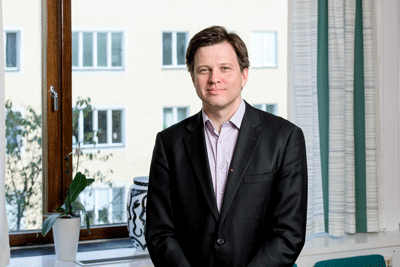
    Henrik Malm Lindberg

    0768587956 henrik.lindberg@ratio.se
  • Professor, Founder and former CEO

    Nils Karlson

    +46708670351nils.karlson@ratio.se

Similar content

Working paper

Working Paper No. 383 Insider activism in the forest industry: An empirical public choice analysis

Jonas Grafström & Nils Karlson
Download

Publication year

2025

Published in

Ratio Working Paper Series

Abstract

Insider activism—where bureaucrats use discretionary power to advance own ideological goals—has significant implications for regulatory stability and property rights security. Using the Swedish forestry industry as a case study, the purpose of this study is to investigate if insider activism affects the Swedish forestry sector and how such possible regulatory uncertainty influences economic decision-making. Assembled survey data suggest that forest owners perceive regulatory enforcement as unpredictable, leading to defensive actions such as premature harvesting to preempt restrictive future regulations. To explain these patterns, we apply public choice theory and a game-theoretic approach, demonstrating how bureaucratic drift, regulatory ratcheting, and time-inconsistency problems contribute to persistent distortions in forestry policies. Policy wise, the findings emphasize the need for judicial review, regulatory impact assessments, and clearer legislative mandates to reduce enforcement uncertainty and improve institutional trust. This research advances discussions on bureaucratic incentives, regulatory capture, and legal certainty in environmental policy.

Book

Reviving Classical Liberalism Against Populism

Karlson, N. (2024). Reviving Classical Liberalism Against Populism. Palgrave Macmillan Cham.

Publication year

2024

Published in

Palgrave Macmillan Cham.

Abstract

How can we fight back against the populist threat to liberty, free markets, and the open society?

This open access book by Nils Karlson explores the strategies used by left- and right-wing populists to make populism intelligible, recognizable, and contestable. Karlson argues that to fight back requires the revival of liberalism itself by defending and developing the liberal institutions, the liberal spirit, liberal narratives, and liberal statecraft. The book presents a synthesized explanatory model for how populists promote autocratization through the deliberate polarization of society and traces the ideational roots of the core populist ideas that form a collectivistic identity politics. Written within the tradition of political theory and institutional economics, this book uses a wide variety of sources, including results and analyses from social psychology, ethics, law, and history.

The book is open source and can be downloaded through the link below.

Working paper

Ratio Working Paper No. 353: From free competition to fair competition on the European internal market

Karlson, N., Herold, T. & Dalbard, K.
Download

Publication year

2022

Published in

Ratio Working Paper

Abstract

This paper investigates whether an increased use and reinterpretation of what has been called “fair competition” has occurred at the expense of “free competition” among the central institutions of the European Union. We are also interested in assessing how frequently these terms have been used by the various EU institutions over time.

We have empirically examined this through a quantitative survey of more than 12,000 public documents, out of totally 242 000 documents containing 630 million words, in the EUR-lex database over the last 50 years, from 1970 to 2020. Our conclusion is that the emphasis of the common policies in the EU is likely to have shifted from free competition and an open market economy to “fair competition” in the sense of a level playing field, in official EU documents, such as treaties, EU acts institutions, preparatory documents relating to EU directives and recommendations including motions and resolutions, case law and more.

The European Commission has been a driving force in this development, followed closely by the European Parliament and subsequently by the Council of Ministers. This change entails a risk that the regulation of the European internal market has shifted so that the dynamics of the internal market and thus the EU’s competitiveness will weaken. The change also entails a centralization of decisions at EU level at the expense of the Member States.

Show more