Ratio light logo

Ratio är ett fristående forskningsinstitut som forskar om företagandets villkor.

08-441 59 00info@ratio.se

802002-5212

Sveavägen 59 4trp

11359 Stockholm

Bankgiro: 512-6578

PublikationerEvenemangMedarbetare

Populärt

Unga forskare
Nyhetsarkiv
Publikationer
Evenemang
Medarbetare
Start
Publikationer
Forskning i korthet
Rapportserie arbetsmarknad
Arbetsmarknad
Klimat och miljö
Konkurrenskraft
Projekt
Evenemang
RatioTV
Ratio dialogue
Detta är Ratio
VD berättar
Styrelse
Ledning
Verksamhetsberättelse
Medarbetare
Forska hos oss
Kontakta oss
Om programmet
Stipendium för unga forskare
Praktik
Sommarassistent på Ratio
Eli F. Heckscher-föreläsning
AI-Econ Lab
Bli medlem
Press & media
Nyhetsbrev
Nyhetsarkiv
Vanliga frågor
Integritetspolicy
Engelska flaggan ikonIn English
PublikationBok

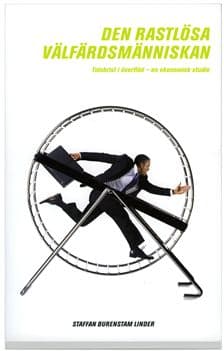
Den rastlösa välfärdsmänniskan: tidsbrist i överflöd

Sammanfattning

Ratio Förlag presenterar en nyutgåva Staffan Burenstam Linders klassiker “Den rastlösa välfärdsmänniskan. Tidsbrist i överflöd – en ekonomisk studie” som utkom första gången 1969. Boken, som snabbt blev en internationell bestseller och översattes till elva språk, är en modern klassiker med dagsaktuell relevans.

Ju rikare vi blir, desto mer stressade och rastlösa tycks vi bli. Tidsbrist är ett av nutidens största gissel. Trots att det rimligen borde vara tvärtom. Borde inte det ökade välståndet leda till att vi får ökad tid till avkoppling, lek, umgänge och rekreation? Denna paradox är utgångspunkten för Staffan Burenstam Linders briljanta analys.

Staffan Burenstam Linder (1931-2000) var professor i nationalekonomi och rektor vid Handelshögskolan i Stockholm. Han var även riksdagsledamot, förste vice ordförande för Moderaterna, handelsminister i 1970-talets borgerliga regeringar samt ledamot av Europaparlamentet. Dessutom var han ordförande i riksbanksfullmäktige.

Burenstam Linder, S. (2008). Den rastlösa välfärdsmänniskan: Tidsbrist i överflöd – en ekonomisk studie. Stockholm. Ratio Förlag.

Gary S. Becker, professor vid University of Chicago, mottagare av Sveriges Riksbanks pris i ekonomisk vetenskap till Alfred Nobels minne samt god vän till Staffan Burenstam Linder, har skrivit en ny introduktion till denna utgåva. Docent Nils Karlson, VD Ratio, har skrivit ett förord.

Detaljer

Författare
Burenstam Linder, S.
Publiceringsår
2008
Publicerat i

Den rastlösa människan

Relaterat

  • Nyhetsartikel

    Semestertider är bråda tider för rastlösa nutidsmänniskor

    Semestertider är bråda tider för rastlösa nutidsmänniskor – Dagens nyheter Ekonomikrönika om den av Ratio nyutgivna boken Den rastlösa välfärdsmänniskan.

    Publicerat 20 juni 2008
    Läs hela
  • Nyhetsartikel

    Gå mer på teater, Almi!

    Gå mer på teater, Almi! – Svenska dagbladet Referens till boken Den rastlösa välfärdsmänniskan

    Publicerat 21 april 2008
    Läs hela

Liknande innehåll

Artikel (med peer review)

The openness of open innovation in ecosystems

Öberg, C., & Alexander, A.

Publiceringsår

2019

Publicerat i

Journal of Innovation & Knowledge

Sammanfattning

Open innovation has rendered increased interest both in practice and research, and has expanded from dyadic transfers of ideas, to ecosystem levels. Knowledge is at the heart of open innovation, and this paper describes and discusses knowledge-transfer linkages for open innovation. It does so based on a literature review. The paper links together open innovation research with general management research to categorise and discuss linkages among parties in terms of their openness and how they relate to knowledge management. Conclusions indicate that openness needs to be considered in different dimensions that also links to different knowledge management outcomes. The paper’s contribution consists of how it connects open innovation research to the general management literature, and how it builds a practical understanding of how linkages between firms can be categorised to aid firms to consider which mechanisms they may choose and why.

Artikel (med peer review)

A revised perspective on innovation policy for renewal of mature economies – Historical evidence from finance and telecommunications in Sweden 1980–1990

Eriksson, K., Ernkvist, M., Laurell, C., Moodysson, J., Nykvist, R. & Sandström, C.

Publiceringsår

2019

Publicerat i

Technological Forecasting and Social Change

Sammanfattning

What is the role of innovation policy for accomplishing renewal of mature industries in Western economies? Drawing upon an unusually rich dataset spanning 9752 digitized archival documents, we categorize and code decisions taken by policymakers on several levels while also mapping and quantifying the strategic activities of both entrant firms and incumbent monopolists over a decade. Our data concerns two empirical cases from Sweden during the time period 1980–1990: the financial sector and the telecommunications sector. In both industries, a combination of technological and institutional upheaval came into motion during this time period which in turn fueled the revitalization of the Swedish economy in the subsequent decades. Our findings show that Swedish policymakers in both cases consistently acted in order to promote the emergence of more competition and de novo entrant firms at the expense of established monopolies. The paper quantifies and documents this process while also highlighting several enabling conditions. In conclusion, the results indicate that successful innovation policy in mature economies is largely a matter of strategically dealing with resourceful vested interest groups, alignment of expectations, and removing resistance to industrial renewal.

Artikel (med peer review)

Municipally Owned Enterprises as Danger Zones for Corruption? How Politicians Having Feet in Two Camps May Undermine Conditions for Accountability

Bergh, A., Erlingsson, G., Gustafsson, A. & Wittberg, E.

Publiceringsår

2019

Publicerat i

Public Integrity

Sammanfattning

The market-inspired reforms of New Public Management have been particularly pronounced in Swedish local government. Notably, municipally owned enterprises (MOEs) have rapidly grown in numbers. Principal-agent theory gives rise to the hypothesis that the massive introduction of MOEs has impacted negatively on the conditions for accountability in Swedish local government. To study this, social network analysis was employed in mapping networks for 223 MOEs in 11 strategically chosen municipalities, covering a total of 732 politicians. The analysis reveals substantial overlaps between principals (representatives of the ultimate stakeholders, citizens) and agents (the boards of the MOEs). Hence, corporatization of public services seems to imply worrisome entanglements between the politicians who are set to steer, govern, and oversee MOEs on the one hand, and the board members of MOEs on the other. The increasing numbers of MOEs may therefore have adverse effects on accountability in important and growing parts of Swedish local government.

Visa fler